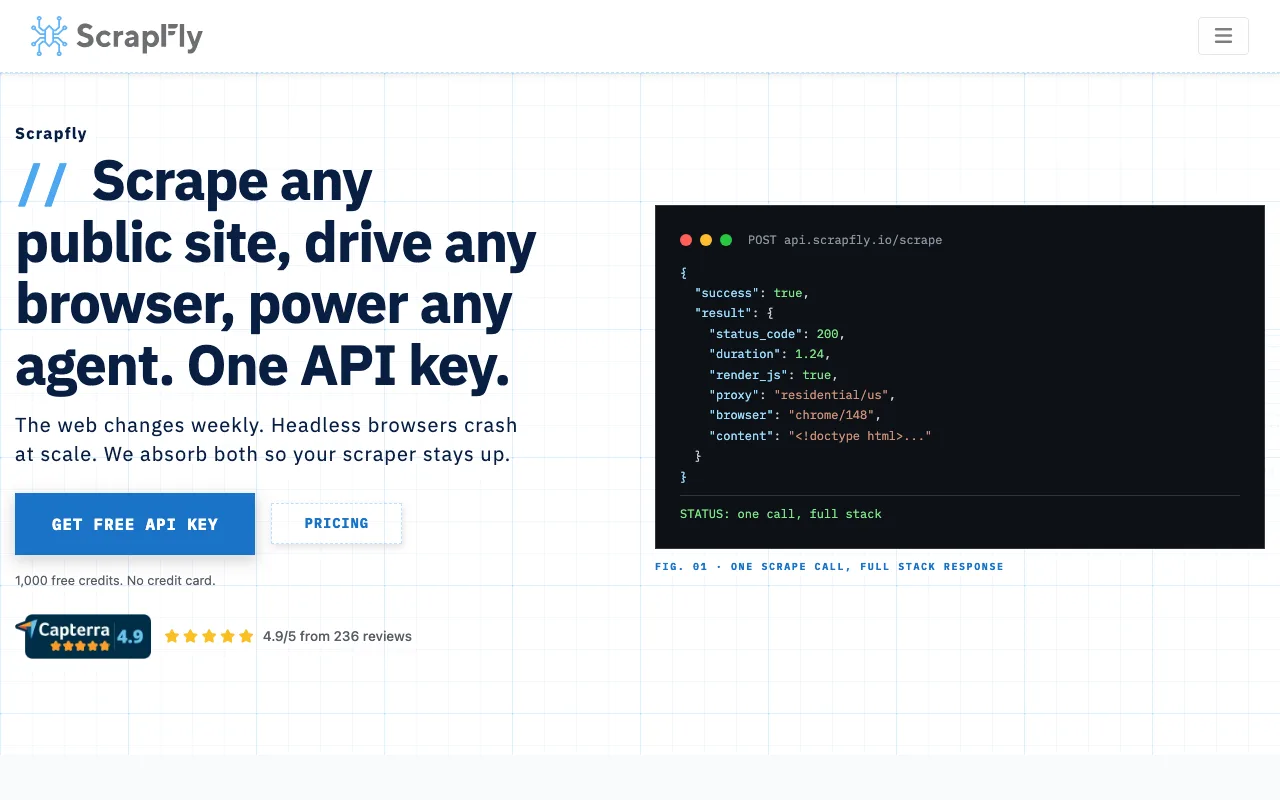
Scrapfly Review
Scrapfly tells you why a request failed and which anti-bot system blocked it, which is the single most useful thing a scraping API can do when things break.
Review last updated 2026-08-20 · How we rate providers
Scorecard
Pros
- Detects and names the specific anti-bot system protecting a target, which is genuinely useful for debugging
- Excellent Python and TypeScript SDKs plus an open-source toolkit
- Detailed per-request logs showing exactly what the platform did
- Low $30 entry point
Cons
- Smaller than the leading platforms
- Credit costs rise sharply for hard targets
- Business-hours support only
- Fewer prebuilt structured extractors than ScraperAPI
Privacy, jurisdiction & audits
Who the company answers to legally, what it keeps, and whether anyone independent has checked.
| Legal jurisdiction | France in the 9 Eyes |
|---|---|
| Logging policy | Not a privacy service; operational logs by design |
| Independent audits | None published |
| Anonymous payment | Card / PayPal only |
| How IPs are sourced | Aggregated residential and datacenter supply from multiple upstream vendors. |
Scrapfly plans & pricing
Advertised rates as of August 20, 2026. VPN promo rates normally require the prepaid term shown and renew at the higher rate; proxy pricing falls with volume. Confirm on Scrapfly's own site before buying.
| Plan | Price | Min spend | Notes |
|---|---|---|---|
| FreeScraping APIs | Freefree forever | Free | 1,000 API credits a month |
| StarterScraping APIs | $0.60/1k requestsmonthly | $30 | |
| ProScraping APIs | $0.40/1k requestsmonthly | $100 |
Features
Our Scrapfly review
Most scraping APIs return a failure and leave you guessing. Scrapfly reports which anti-bot product is protecting the target, what fingerprinting was attempted, and what the platform did to work around it, with per-request logs you can actually read.
When a pipeline that ran fine for months starts failing, that observability is worth more than a slightly lower per-request price, because it turns a guessing game into a diagnosis.
The SDKs for Python and TypeScript are well made, and the company maintains open-source tooling around browser fingerprinting and scraping that is useful even if you never buy the product.
Scale is smaller than ScraperAPI or Zyte, credits multiply for hard targets, and there are fewer ready-made structured extractors for specific sites.
The $30 entry point and permanent free tier make it easy to run alongside another provider and compare on your own targets.
Notable facts
- Reports which anti-bot system is protecting each target
- Maintains open-source scraping and fingerprinting tools
- Free tier of 1,000 credits a month
At a glance
| Founded | 2020 |
|---|---|
| Headquarters | Paris, France |
| Service types | Scraping APIs |
| Country coverage | 50 |
| Proxy protocols | HTTP(S) |
| Rotation | Automatic, with anti-scraping protection detection per target |
| Starting price | Free |
| Free tier | Yes |
| Support | email, chat, knowledge-base |
Frequently asked questions
Why does anti-bot detection reporting matter?
Because different protections need different countermeasures. Knowing which system blocked you turns an unexplained failure into a solvable problem.
Is Scrapfly good for large volumes?
It works, but Zyte and ScraperAPI have more scale and better economics at very high request counts.
Is there a free plan?
Yes, 1,000 credits a month permanently.
Bottom line
Scrapfly tells you why a request failed and which anti-bot system blocked it, which is the single most useful thing a scraping API can do when things break.
Check current Scrapfly pricing →